





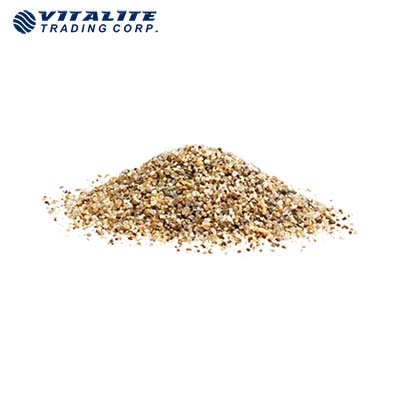
QUARTZ SAND
QUARTZ SAND
The Quartz sand is a type of sand composed primarily of silicon dioxide (SiO2) in the form of quartz grains. It is one of the most common and widely distributed minerals on Earth. Quartz grains are formed by the weathering and erosion of rocks over long periods of time and are often transported by water or wind.
The key characteristic of quartz sand is its high silica content, typically ranging from 95% to over 99%. This makes it extremely durable, chemically inert, and heat-resistant.
Applications
- Drinking water treatment: Primarily a filtration step after coagulation and sedimentation.
- Industrial process water: For use in manufacturing, cooling towers, and boilers.
- Swimming pool filtration: Standard media for commercial and residential sand filters.
- Wastewater treatment: Tertiary treatment stage to polish treated wastewater before it is discharged into the environment or used.
- Septic system: Final treatment step before effluent leaches into the soil.
- Pre-filtration for the membrane system: Pre-treatment step before reverse osmosis (RO) or ultrafiltration (UF) membranes.
Physical and Chemical Characteristics
Silicon dioxide
Iron oxide
Aluminum oxide
Specific gravity
Hardness
Particles size distribution
Whiteness
Uniformity coefficient
Acid solubility
: 98% SiO2
: 0.6% Fe2O3
: 1.1% Al2O3
: 2.65 g/cm³
: 7 Mohs
: 2.4~2.5
: 88~97%
: 1.7
: 5%
