




RESIN H-400
HIGRADE RESIN H-A400
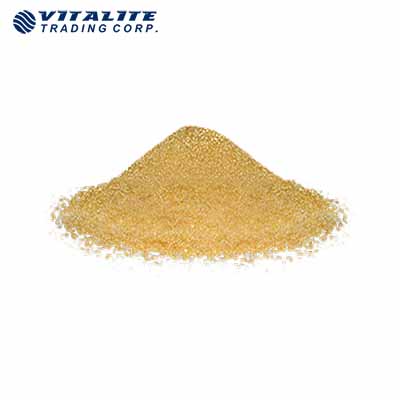
The H-A400 is an industrial-grade, polystyrenic gel, Type I Strong Base Anion (SBA) exchange resin. Commonly supplied in the chloride (Cl-) form, it is highly optimized for water demineralization and silica removal. It is well-regarded for its exceptional physical stability, high operating capacity, and rapid exchange kinetics.
Applications
- Industrial Water Demineralization: Primarily utilized as the anion-exchange component in separate dual-bed or mixed-bed demineralizer systems.
- Silica Removal: Essential in high-pressure boiler feedwater pre-treatment, where minimizing reactive silica is critical to preventing scale formation.
- Mixed Bed Demineralizers: It functions as the anion component in these systems, facilitating effective water purification and separation processes
System Hydraulic Guidelines
- Service Flow Rates: Typically operates efficiently at 10 to 40 BV/h (Bed Volumes per Hour) or linear velocities of 10 to 50 m/h.
- Backwashing and Bed Expansion: During an up-flow backwash, the resin bed volume should be expanded by 50% to 70% for 10 to 15 minutes. This reclassifies the beads, removes suspended solids, and clears trapped air pockets to prevent channeling.
- Note: Because cold water is more viscous, colder influent water increases bed expansion. Backwash flow rates should be adjusted seasonally to prevent washing the resin out of the vessel.
Key Performance & Chemistry Advantages
- Efficient Regeneration: Compared to classical Type I resins, the A400 chemical matrix requires minimal caustic soda (NaOH) for regeneration, maintaining superior rinse characteristics and reducing overall operating costs.
- Low Residual Silica: Because of its Type I quaternary ammonium functional group, it exhibits a very high affinity for weak acids, making it highly effective at achieving exceptionally low levels of residual silica.
- High Thermal Stability: In its chloride (Cl-) form, it has an operating temperature threshold of up to 100°C (212°F), making it highly robust in warm climates or systems where raw water is preheated.
Physical and Chemical Characteristics
Polymer composition: Cross-linked polystyrene gel w/ Divinylbenzene
Functional group: Type I Quaternary Ammonium
Ionic form: Chloride (Cl-)
Total exchange capacity: 1.3 eq/L (Cl- form)
Coefficient of uniformity: <1.7
Operating pH range: 0~14
Specific gravity: 1.08 (Cl- form)
Moisture retention: 48~54% (Cl- form)
Particle size range: 300~1200μm
Maximum temperature: 100°C (Cl- form), 60°C (OH- form)
